


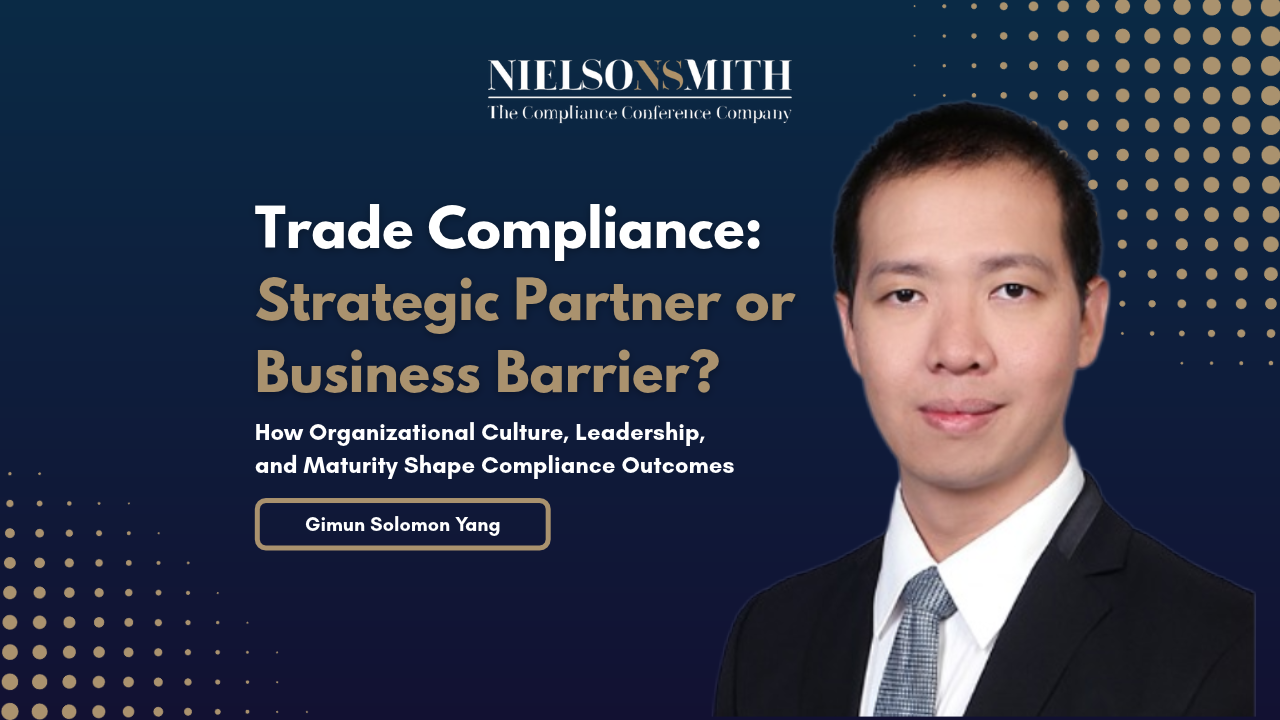

How Organizational Culture, Leadership, and Maturity Shape Compliance Outcomes
By Gimun Solomon Yang
Executive Summary
Trade Compliance plays a critical role in protecting organizations from regulatory, financial, and reputational risk while enabling lawful and efficient trade operations. As sanctions, export controls, customs requirements, and geopolitical complexities continue to evolve, compliance functions are increasingly expected to support business objectives while maintaining regulatory integrity.
Yet in some organizations, Trade Compliance is perceived as an obstacle rather than a business partner. This perception often stems not from regulatory requirements themselves, but from how compliance responsibilities are communicated, enforced, and integrated into broader business processes.
This article examines the organizational factors that influence these perceptions and explores how leadership, governance, training, and culture shape compliance outcomes. It also highlights the characteristics of high-maturity organizations, where Trade Compliance serves as a trusted advisor, supporting both regulatory compliance and commercial success.
Disclaimer
This article reflects the writer’s personal perspectives and professional observations. It is not associated with, influenced by, or representative of any organization the writer currently works for or has previously worked for.
1. Why Trade Compliance Matters
Global trade operates in an environment of increasing regulatory complexity. Sanctions, export controls, customs requirements, ESG expectations, and geopolitical developments require organizations to maintain accurate, transparent, and compliant trade practices.
Trade Compliance exists to ensure that trade-related activities are conducted lawfully, accurately, and consistently. This includes areas such as product classification, customs valuation, origin determinations, licensing requirements, documentation accuracy, and adherence to applicable trade regulations.
Effective Trade Compliance protects organizations from penalties, shipment delays, supply-chain disruptions, and reputational harm. It also helps build trust with customs authorities, regulators, customers, suppliers, and other stakeholders.
The function’s responsibilities extend beyond regulatory compliance. Trade Compliance contributes to operational resilience, supports efficient customs clearance, improves supply-chain visibility, and helps organizations make informed commercial decisions in increasingly complex international markets.
For this reason, modern Trade Compliance should not be viewed as a control function operating independently from the business. Instead, it should be integrated into commercial decision-making and work closely with procurement, logistics, finance, tax, legal, and operational teams.
When implemented effectively, Trade Compliance becomes a strategic enabler of sustainable global growth rather than an administrative checkpoint.
2. Why Compliance Sometimes Creates Friction
Despite its intended purpose, Trade Compliance can sometimes be perceived as a source of friction within an organization. In most cases, this perception does not arise from the regulations themselves but from how compliance requirements are communicated, enforced, and supported.
When compliance decisions lack transparency, when business teams do not understand the underlying rationale, or when issues are escalated without collaboration, Trade Compliance may be viewed as a barrier rather than a partner. This can lead to resistance, reduced engagement, and missed opportunities for proactive risk management.
Several organizational factors commonly contribute to this perception.
Low Organizational Maturity
Organizations with limited governance structures, unclear procedures, or inconsistent decision-making processes often rely heavily on individuals rather than established systems. In such environments, compliance decisions can appear subjective or inconsistent, creating unnecessary tension between compliance and business functions.
Leadership Gaps
Leadership teams play a critical role in defining how Trade Compliance operates within the organization. When leaders fail to distinguish genuine regulatory risk from operational inefficiencies, compliance functions may become overly restrictive or disconnected from business realities.
Without clear expectations and accountability, Trade Compliance risks being viewed as an obstacle rather than a contributor to business success.
Fear-Based Organizational Cultures
Organizations that rely heavily on hierarchy, punitive communication, or excessive escalation often create environments where employees hesitate to ask questions or raise concerns.
In these settings, compliance interactions may feel like enforcement rather than guidance, discouraging collaboration and reducing transparency across functions.
Insufficient Training and Awareness
Trade Compliance is a highly specialized and constantly evolving discipline. When business teams receive limited training on customs, export controls, sanctions, or trade regulations, significant knowledge gaps emerge.
As a result, routine compliance requirements may appear arbitrary or unnecessarily restrictive simply because employees do not understand the underlying regulatory obligations.
Overreliance on Authority
Compliance professionals are often required to make difficult decisions and challenge business activities that present regulatory risk. However, when authority replaces explanation, collaboration, and education, even well-intentioned compliance decisions can generate resistance.
The most effective compliance functions focus not only on what decisions are made but also on how those decisions are communicated.
3. Characteristics of High-Maturity Trade Compliance Organizations
High-maturity organizations approach Trade Compliance differently. Rather than relying primarily on authority and control, they build compliance cultures based on transparency, collaboration, accountability, and trust.
In these environments, Trade Compliance is viewed as a strategic advisor that helps the organization navigate regulatory complexity while supporting business objectives.
Education and Awareness
Successful compliance cultures prioritize continuous learning. Employees are encouraged to ask questions, seek clarification, and develop a practical understanding of trade regulations.
Trade Compliance professionals act as educators, helping colleagues understand not only what is required but also why those requirements exist.
This approach improves decision-making, reduces errors, and strengthens organizational ownership of compliance responsibilities.
Transparent Decision-Making
Trust grows when compliance decisions are supported by clear regulatory references, documented procedures, and consistent reasoning.
Employees are more likely to support compliance requirements when they understand the legal basis, business implications, and potential consequences associated with those decisions.
Transparency also reduces perceptions of inconsistency and promotes confidence in compliance processes.
Cross-Functional Collaboration
Modern trade regulations often affect multiple functions simultaneously. Customs, export controls, sanctions, tax, procurement, logistics, legal, finance, and operations frequently intersect within the same transaction.
As a result, effective Trade Compliance requires collaboration rather than isolation.
Organizations that involve compliance early in business processes are better positioned to identify risks, avoid delays, and develop practical solutions that support both regulatory and commercial objectives.
Clear Governance and Accountability
High-performing organizations establish clear procedures, responsibilities, and decision-making frameworks.
Documented SOPs, defined escalation pathways, and well-structured RACI models help eliminate ambiguity and ensure accountability across functions.
When governance structures are clear, employees know where to seek guidance, compliance decisions become more consistent, and dependency on individual interpretations is reduced.
Learning from Mistakes
Errors are inevitable in complex global trade environments. Mature organizations focus on understanding root causes, improving processes, and strengthening controls rather than assigning blame.
This approach encourages transparency and enables organizations to identify issues before they develop into significant compliance failures.
4. Leadership Shapes Compliance Culture
Leadership is one of the most important factors influencing how Trade Compliance is perceived throughout an organization.
Leaders establish expectations, allocate resources, define priorities, and shape organizational culture. Their actions determine whether Trade Compliance is viewed as a strategic partner or merely a control function.
Effective leaders recognize that compliance and commercial objectives are not mutually exclusive. They encourage compliance teams to provide practical guidance, promote collaboration across departments, and communicate regulatory expectations clearly.
At the same time, leaders ensure that business teams understand their own responsibilities in maintaining compliance. Regulatory obligations cannot be delegated entirely to compliance professionals; they require active participation across the organization.
Leaders also play a critical role in investing in training, strengthening governance frameworks, and creating environments where employees feel comfortable raising concerns or seeking clarification.
Most importantly, leaders reinforce the principle that compliance is a shared organizational responsibility rather than the sole responsibility of a single department.
When leadership consistently supports transparency, accountability, and collaboration, Trade Compliance becomes integrated into business operations and contributes to long-term organizational resilience.
5. Conclusion
The effectiveness of Trade Compliance is determined not only by regulations and procedures but also by organizational culture. Where communication is unclear, governance is weak, and accountability is inconsistent, compliance functions may be viewed as obstacles to business objectives. Conversely, organizations that prioritize transparency, collaboration, and education are more likely to build trust across functions and achieve sustainable compliance outcomes.
As global trade becomes increasingly complex, organizations can no longer rely solely on control-based approaches. Trade Compliance must be integrated into business decision-making and supported by strong leadership, clear governance, and continuous learning.
Ultimately, successful Trade Compliance is not about exercising authority. It is about helping organizations navigate regulatory complexity while supporting commercial objectives. When trust, integrity, and collaboration become part of the compliance culture, Trade Compliance evolves from a gatekeeping function into a strategic capability that strengthens resilience, competitiveness, and long-term business success.